
Justice for Negro Leaguers: Restructuring Classic Era Committee
Josh Gibson Foundation webinar February 2026 - "42 for 21"
-
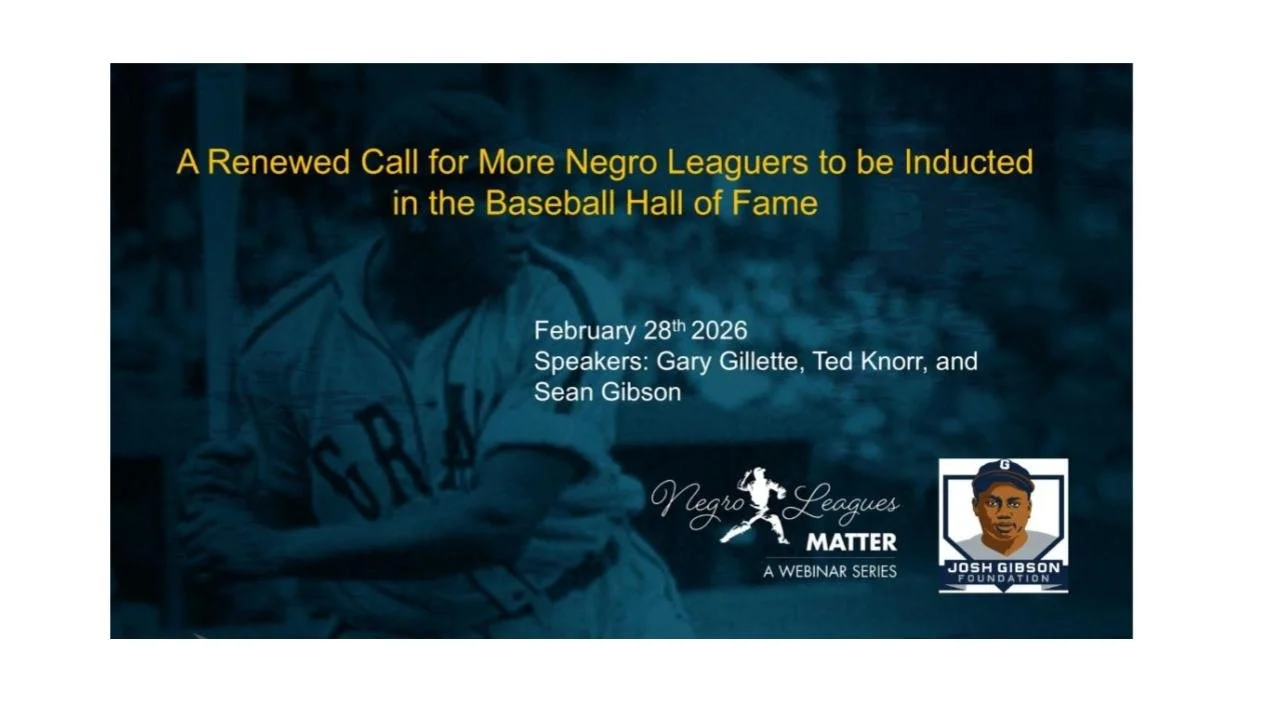
On Saturday, February 28, 2026, the Josh Gibson Foundation was honored to host a “A Renewed Call for More Negro Leaguers to be Inducted in the Baseball Hall of Fame.”
Led by Sean Gibson, Ted Knorr, and Gary Gillette, this extremely well attended webinar of Negro League experts and advocates discussed the importance of encouraging the Baseball Hall of Fame to induct more Negro League greats into the Hall.
We are pleased to affirm our commitment to this endeavor by re-establishing the 42 for 21 initiative that was started several years ago with this very purpose in mind. We acknowledge that the work is not finished and draw your attention to the resources we have posted on this website to renew the campaign, seek greater awareness and support, and ultimately, fulfill our vision that sees all those Negro Leaguers—players, managers, executives, and umpires—who are worthy of the Hall therein enshrined.
Sean Gibson, Executive Director
Josh Gibson Foundation
-
Negro Leaguers and the Baseball Hall of Fame: A Call to Action
We, a community of Negro Leagues historians and advocates, call on the National Baseball Hall of Fame to reevaluate its procedures for electing Negro League greats to the Hall of Fame. A mountain of in-depth historical research on Black Baseball in recent years tells us that the number of outstanding players from the Segregated Era is far more numerous than many had previously thought. Toiling in the shadows of the American and National Leagues for the first half of the 20th Century, Negro Leaguers and their pre-league predecessors nonetheless rivaled their White counterparts, often besting them in head-to-head contests. They present a Who’s Who of Black athletes and executives whose careers fully merit enshrinement.
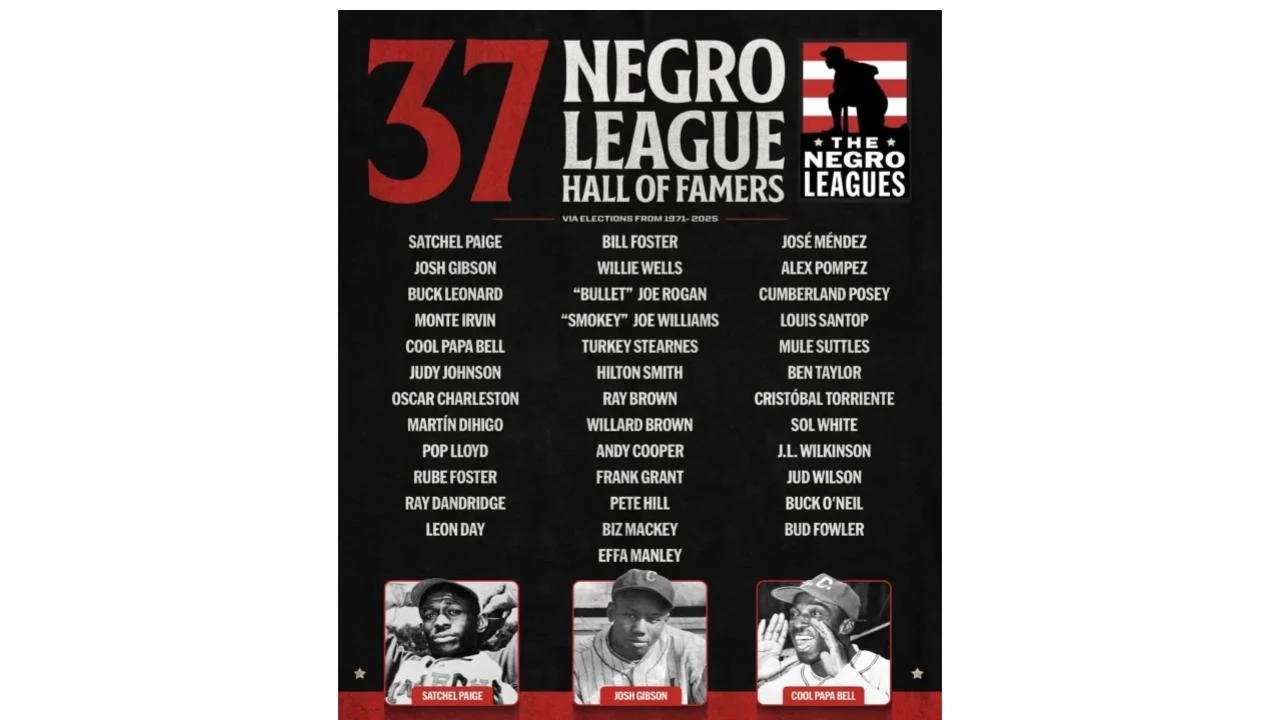
Beginning in 1971, Negro Leaguers have been elected by two special committees and multiple iterations of the Hall of Fame’s Veterans and Era Committees. With better statistical evidence now available, and with the Major Negro Leagues now included in the official records of Major League Baseball, an extremely strong case can be made that more should be represented in Cooperstown. The presence of additional, deserving Negro League & Black Baseball stars would enhance the history of the game as well as lift the legacy of all facets of our National Pastime.
--42 for 21 Committee Members
-
from the February 2026 Josh Gibson Foundation webinar
“MANY SATCHELS, MANY JOSHES”
Many thanks to y’all for joining us today. You’ve heard what my colleagues Sean Gibson and Ted Knorr have to say, and I hope that you have been impressed by the recitation of the historical evidence. It is undeniable that Black players from the National Pastime’s Segregated Era are substantially underrepresented in Cooperstown.
I have some additional comments I’d like to offer for your consideration. Unfortunately, I don’t believe that—in the memorable words of the Captain in Cool Hand Luke: “What we’ve got here is . . . failure to communicate.” Communication between the Hall of Fame and the baseball public is just fine; what is not fine is the Hall’s defense of its careful gerrymandering of its electorate.
The carefully chosen words and the actions of the Hall of Fame speak clearly to their apparent goal of restricting future election of Black players, managers, executives, and umpires from the Segregated Era to the Hall.
Weirdly, while critics of proposals to elect more Negro Leaguers to the Hall often decry the supposed “quota systems” of these initiatives, it’s actually the Hall itself that is intent on enforcing an informal, but strict, quota system of its own.
If you think that’s unfair, I ask you: When has the Hall of Fame been proactive when related to including Negro Leaguers, as opposed to being reactive to public pressure?
I’d like to see a show of hands for all those who think that—absent Ted Williams’s unexpected and brave plea at his 1966 induction—the Hall would not have taken another decade or more before setting up its first Negro Leagues Committee.
No hands? As I expected, we all know that it was only the major public embarrassment that an icon like Williams could generate that forced the Hall to act. Yet unbelievably, the Hall initially proposed a new, Jim Crow Hall: a “separate-but-equal” wing for the Negro Leaguers. The hall was quickly forced to retreat from that indefensible position after a tidal wave of criticism.
Even then, the attempt to constrict the number of Negro Leaguers continued, as the Hall pressured its initial Negro League Committee to disband after electing only nine players—not coincidentally, those nine neatly filled out a starting lineup with one player per position. (That lineup was enabled by the convenient assignment of versatile great Martin Dihigo to the keystone sack.)
What will it take to get the grand panjandrums in Cooperstown to lower the de facto barriers they have set up to prevent more Black Hall of Famers from the Segregated Era from being added to the hallowed Plaque Gallery—the sanctum sanctorum of the National Pastime?
No one knows for sure, but it certainly won’t happen without another sustained public outcry about the ridiculously unfair structure of the Era Committees. Let me read to you the exact text from the Hall of Fame’s website describing the history and function of the Era Committees:
ERA COMMITTEES ELECTION
The Era Committee has been a part of the Hall of Fame voting process since the first class of electees in 1936, with the first Era Committee electees coming in 1937.
The Era Committees, formerly known as the Veterans Committee, consider retired Major League players no longer eligible for election by the BBWAA, along with managers, umpires and executives.
Notice anything? One of the salient facts about the various incarnations of the Veterans/Era Committee system is its almost complete failure to elect any Negro League managers or umpires. Is anyone capable of keeping a straight face when they say that a half-century of segregated baseball could not produce one Hall-worthy manager or umpire? Really? Seriously? Pull the other one!
As for Segregated Era executives, the Veterans/Era Committees have elected only one executive, Black Baseball titan Rube Foster. What about the other four executives elected, you ask? Effa Manley, Alex Pompez, Cum Posey, and J.L. Wilkinson were elected in the special 2006 process, not by any Veterans or Era Committee. What about Sol White, Frank Grant, Bud Fowler, and Buck O’Neil, you point out—all of whom are shown as Executives on the Hall’s official website? They are more aptly described as Pioneers, one of five categories for induction, but that category has essentially been abandoned by the Hall for no good reason.
The sad truth is that only Rube Foster—a no-brainer selection whose greatness even the brainless could recognize—is the only executive, manager, or umpire from the Segregated Era that has been allowed through the bronze portals of the Hall in the half-century since 1971.
When Satchel Paige was finally inducted into the Hall of Fame in ‘71, he said in his speech that “there were many Satchels and many Joshes.” We can forgive his rhetorical hyperbole there, and one can easily argue there was no pitcher as great as Paige and no player as great as Gibson.
Paige’s point, however, is spot-on. There were many great Black players in the Segregated Era—far more than have since been immortalized in bronze in Cooperstown. It’s great that underappreciated outfielder Pete Hill has a plaque, yet the brilliant but almost unknown outfielder Rap Dixon does not. Shortstop Pop Lloyd was inducted in 1971, and Willie Wells in 2006, but King Richard, the great shortstop Dick Lundy, has been excluded along with Grant “Home Run” Johnson—perhaps the best Black player of the 19th Century. Intimidating, flamethrowing hurlers like Paige and Joe Williams have been honored, but Cannonball Dick Redding remains on the outside, virtually anonymous.
In conclusion, I’d like to repurpose an oft-referenced phrase from American history that seems appropriate to describe the Hall of Fame’s history in this regard. In the Supreme Court’s precedent-shattering Brown v. Board of Education ruling in 1954, the Court ordered that segregation should be ended “with all deliberate speed.” Unfortunately, that unclear language gave enough latitude for recalcitrant Southern states to disingenuously drag out the desegregation process.
It has now been 55 years since the legendary Satchel Paige took his rightful place in Cooperstown, yet we are still struggling to end discrimination against the great Black players.
-
While the Era Committees have righted several wrongs and elected some deserving players, the move to having one era span from baseball's origins to 1979 changed everything and is particularly detrimental to Negro Leagues candidates.
There are just eight finalists on every ballot with voters being allowed to vote for up to three. Numbers-wise it is tough for anyone to get in, but this ballot is spans so long it is worse for Negro Leagues players.
Popular deserving major leaguers like Luis Tiant, Ken Boyer, Thurman Munson and Tommy John have been finalists. If they are again, then you add the top pre-integration candidate Bill Dahlen and that leaves three spots at the most for Negro Leaguers. Cannonball Dick Redding, John Donaldson, Vic Harris and Grant "Home Run" Johnson have been finalists in this format.
So how are voters, who are Hall of Fame players as well as executives and a couple of media members and two Negro Leagues historians, supposed to come to a consensus on there?
Luis Tiant or Cannonball Dick Redding? Bill Dahlen or Home Run Johnson? Tommy John or John Donaldson?
It will be tough for any candidate to get 75% but it will require the Negro Leagues historians to educate the committee and likely narrow in on one candidate at a time.
That would lead to, say, the election of Luis Tiant AND Cannonball Dick Redding. But even that would take the right education, the right people and the right timing on the Era Committee.--Dan D’Addona
Presentation by Ted Knorr
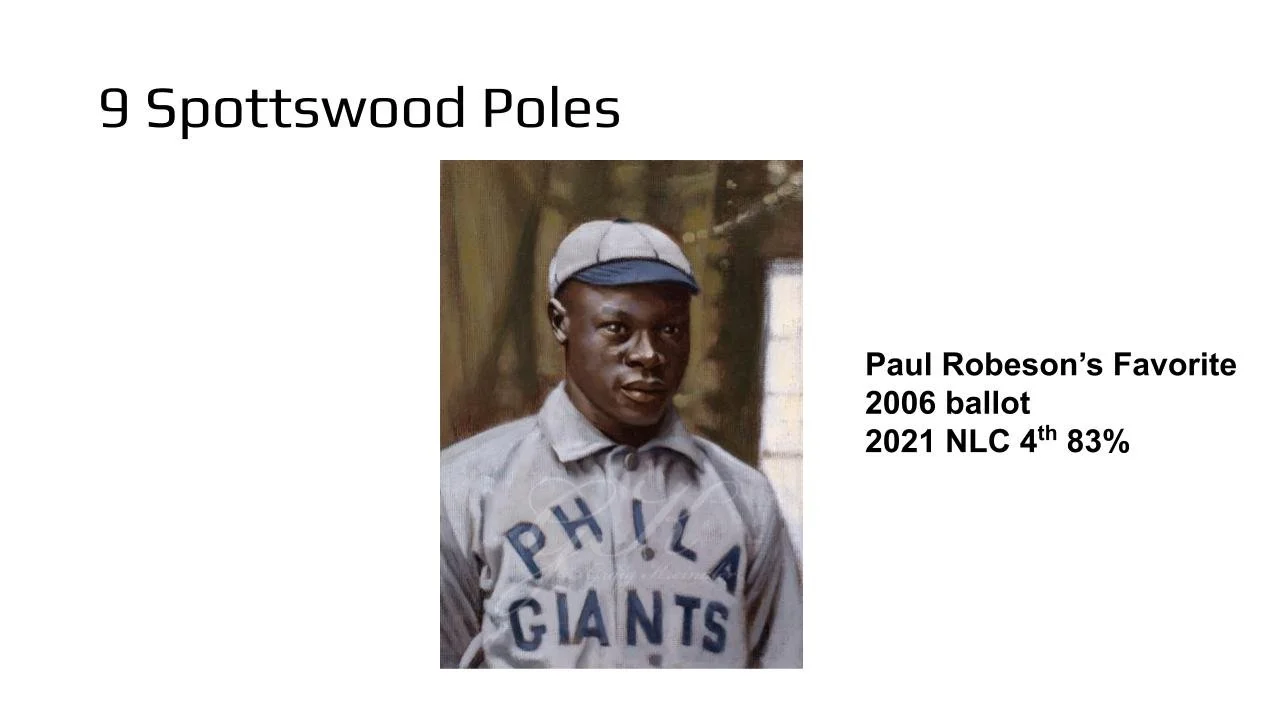
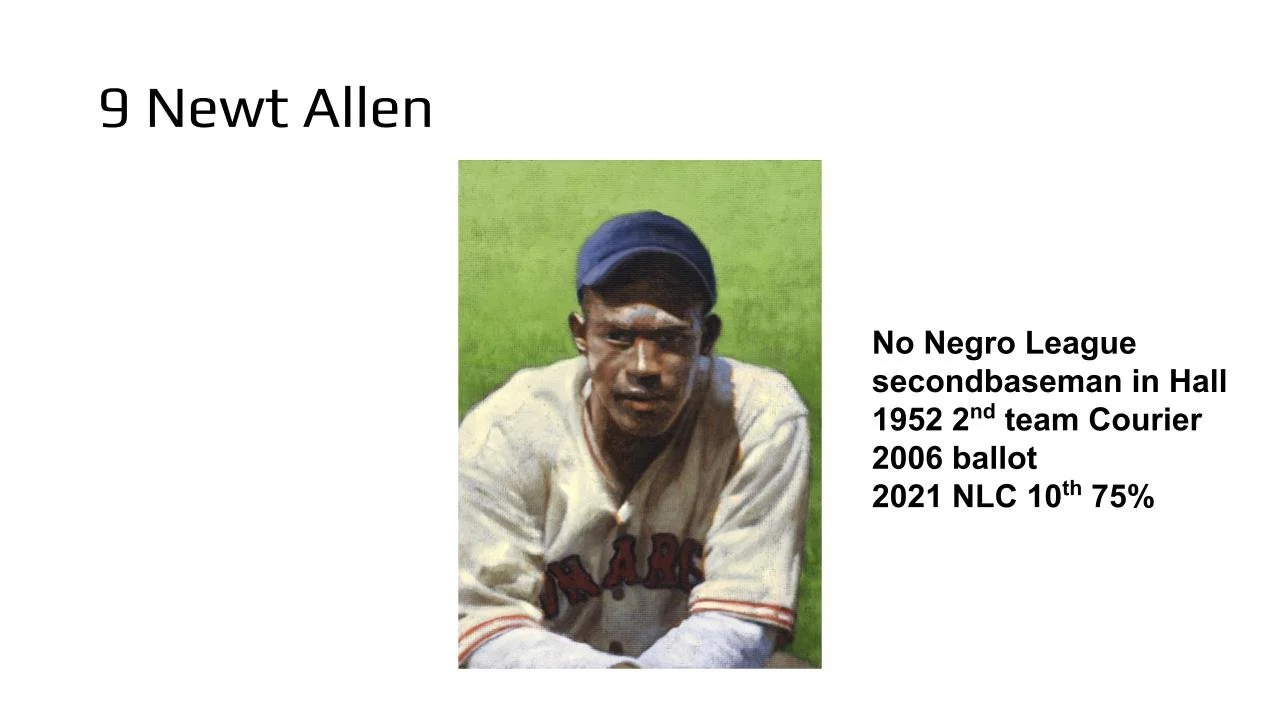
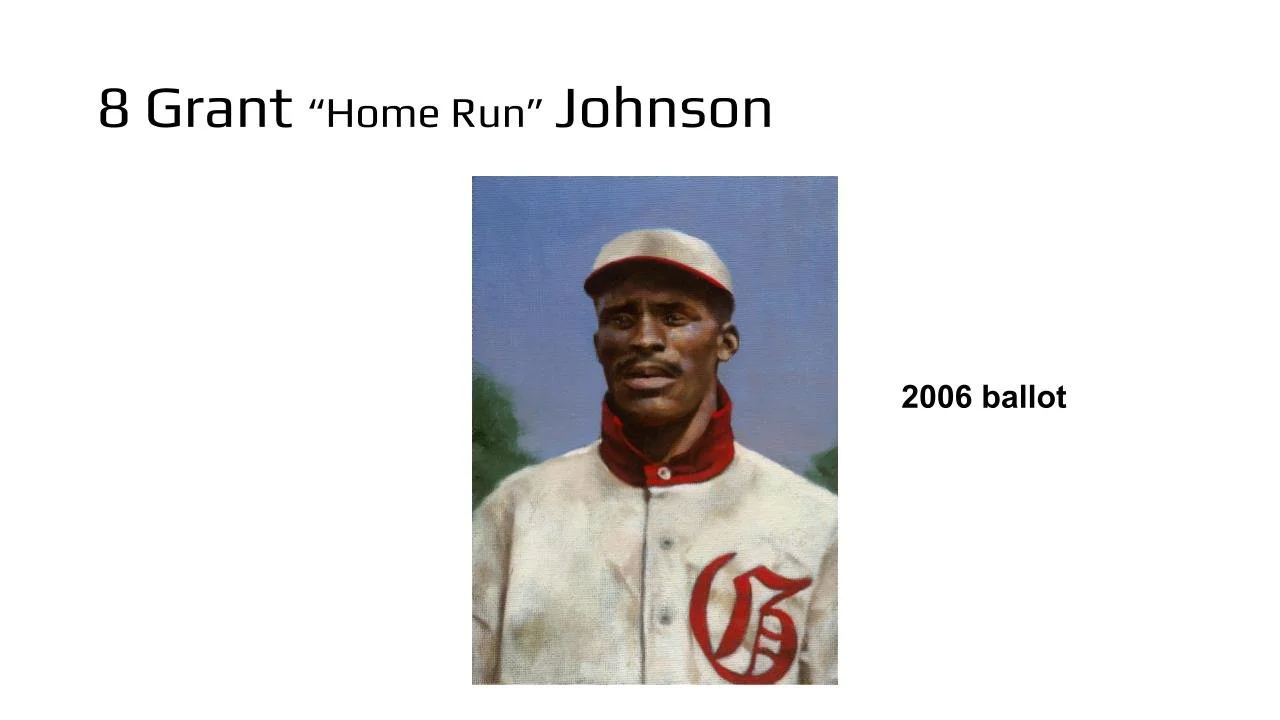
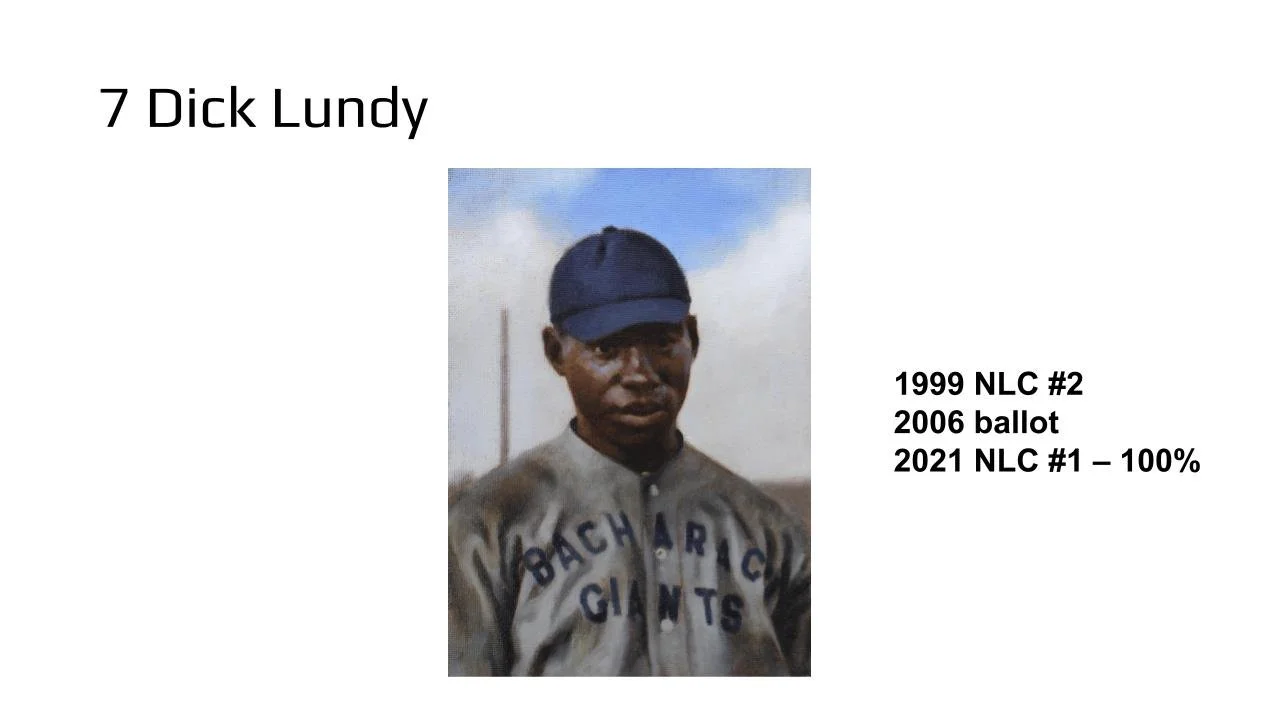
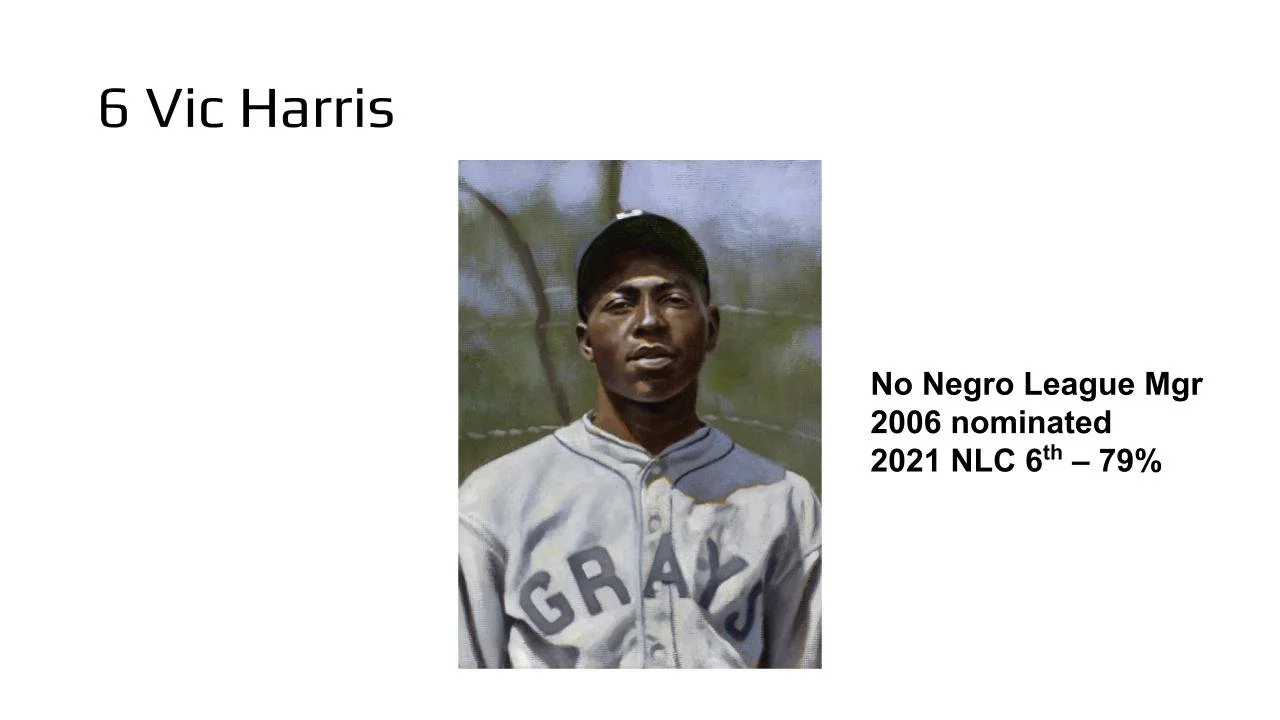
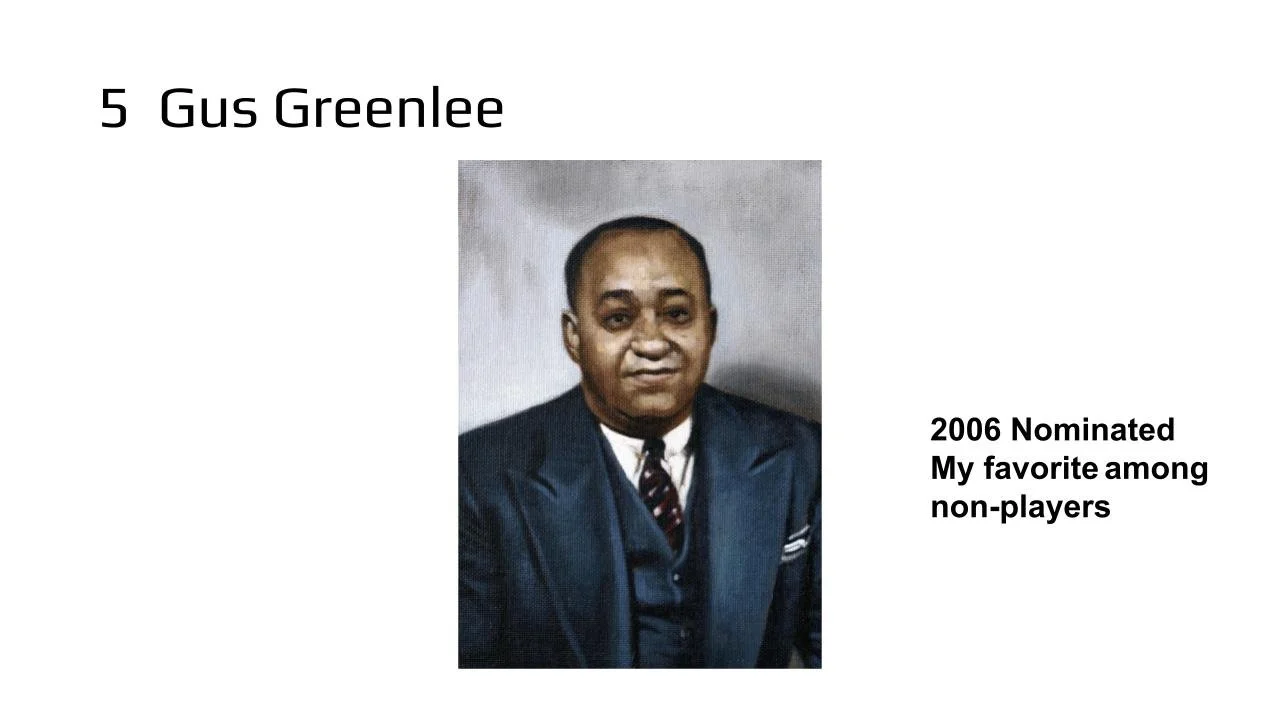
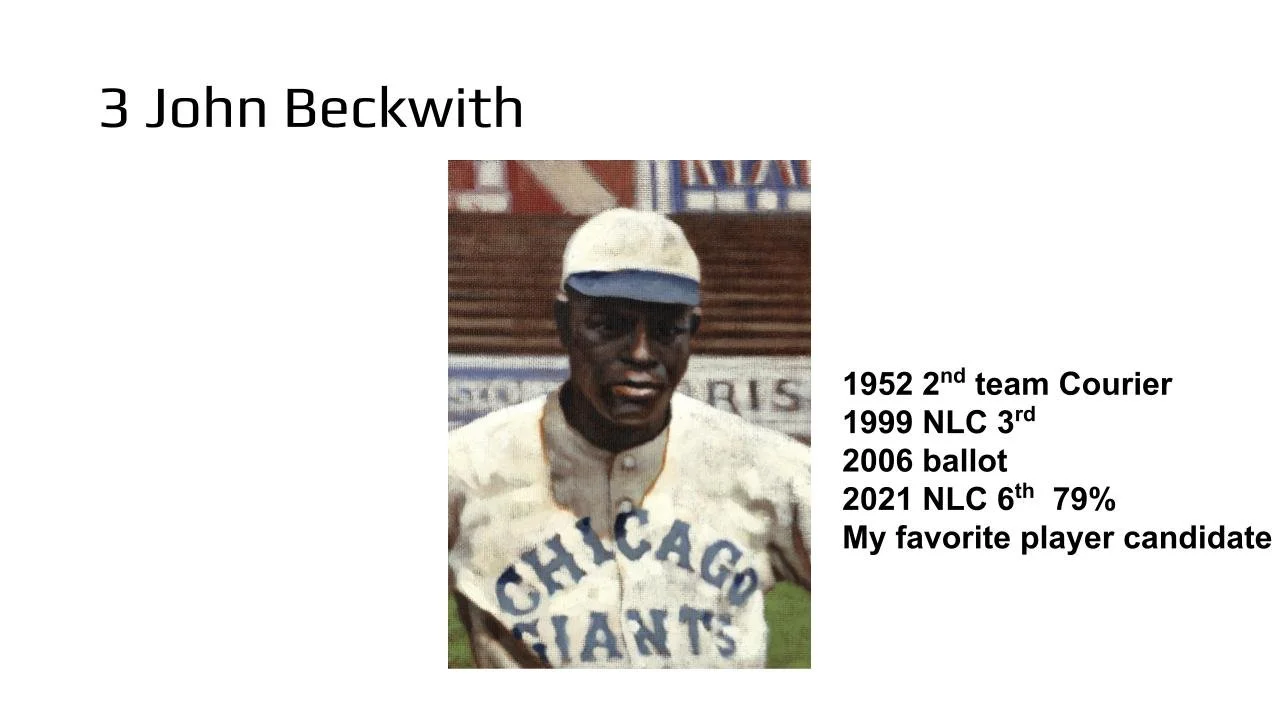
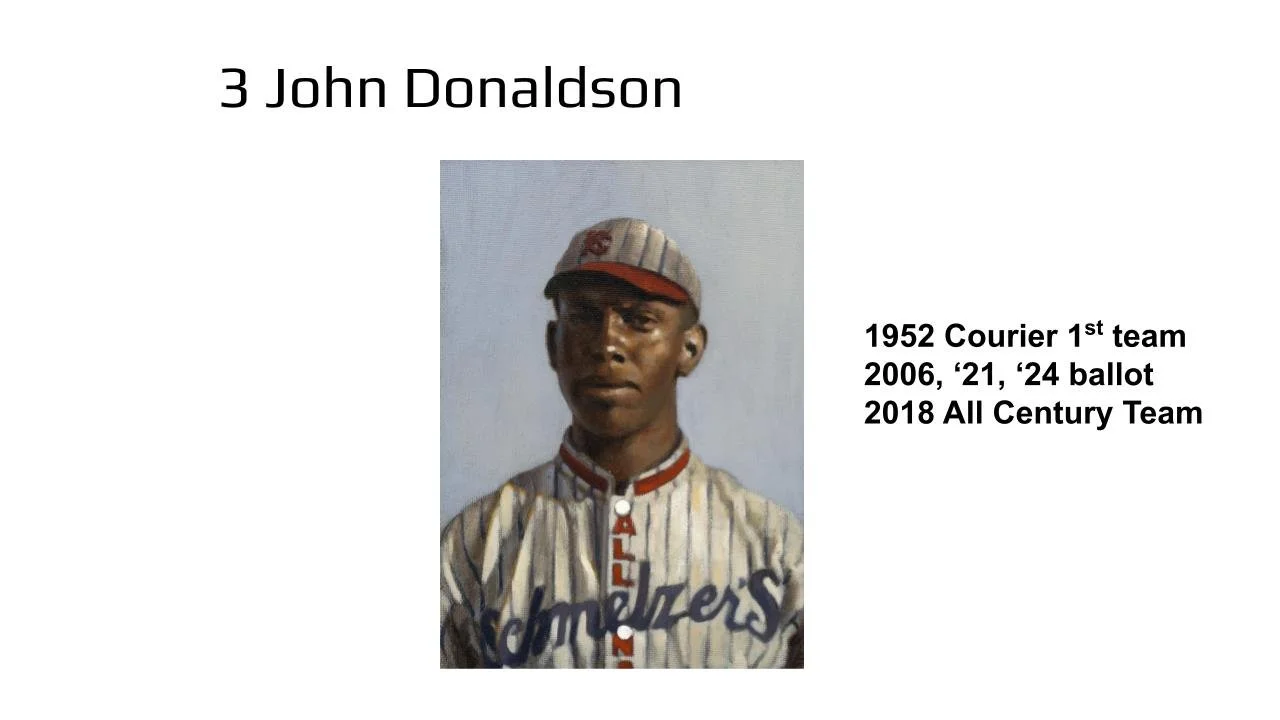
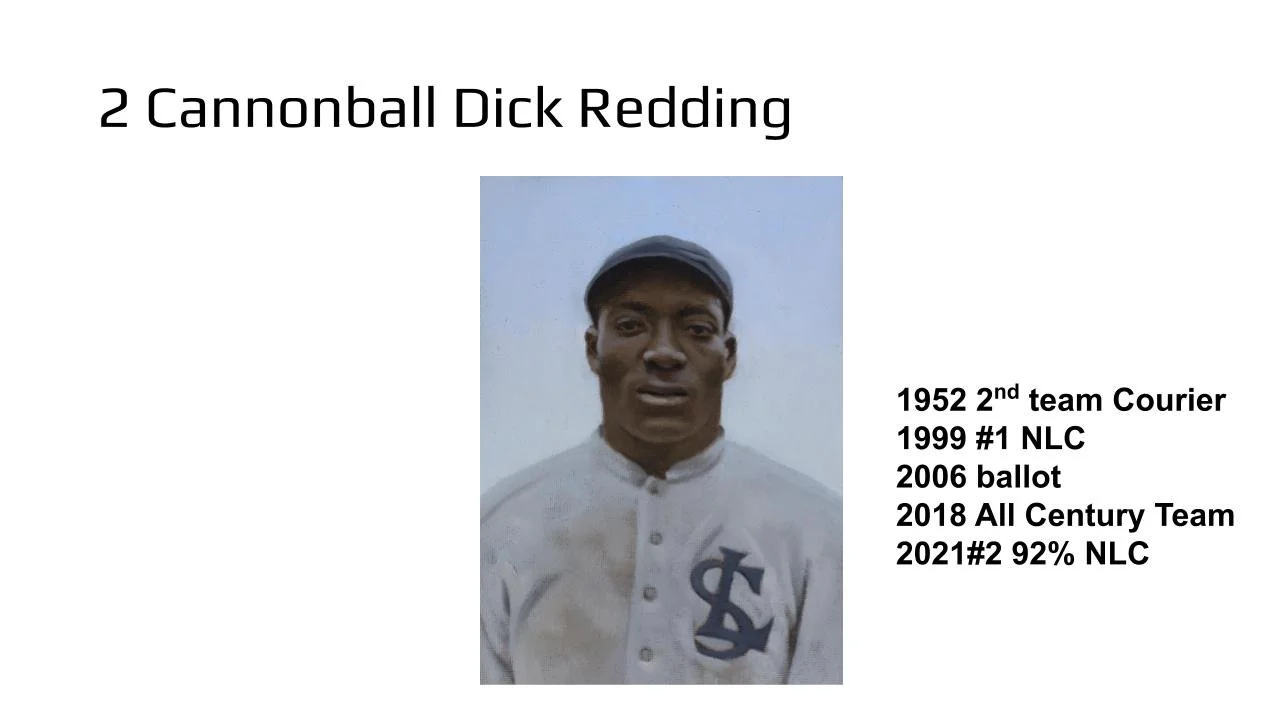
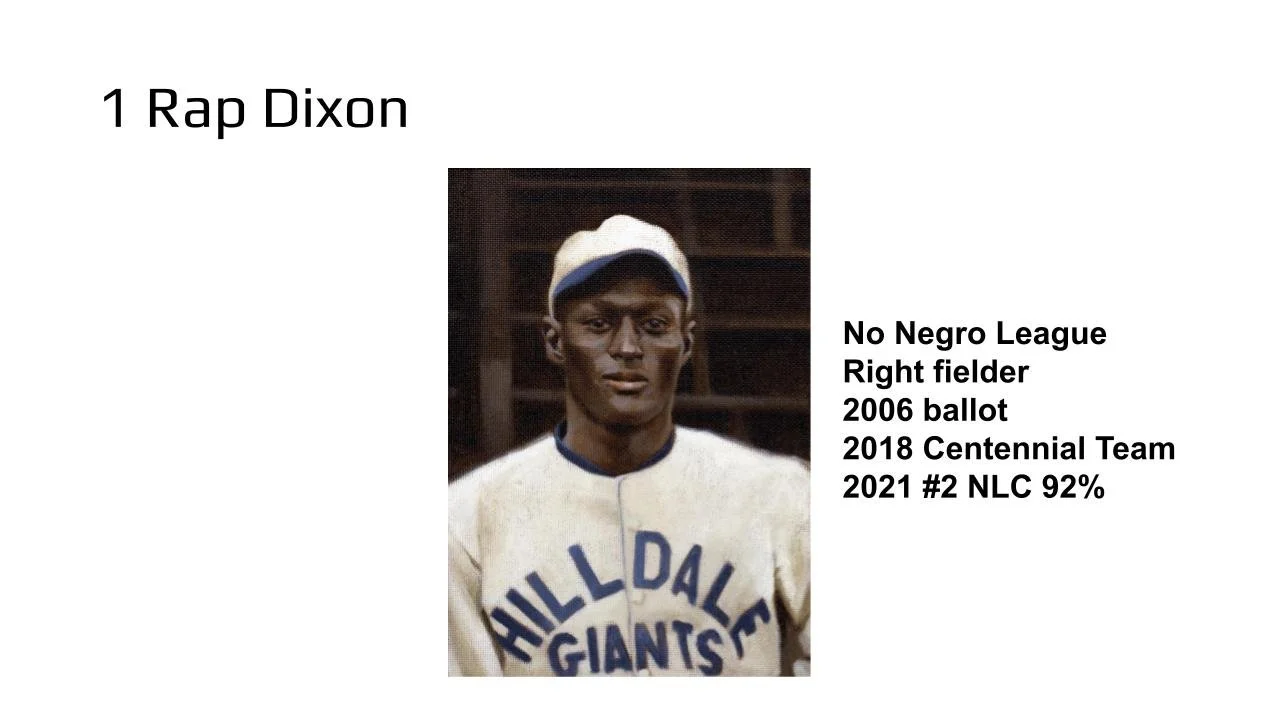
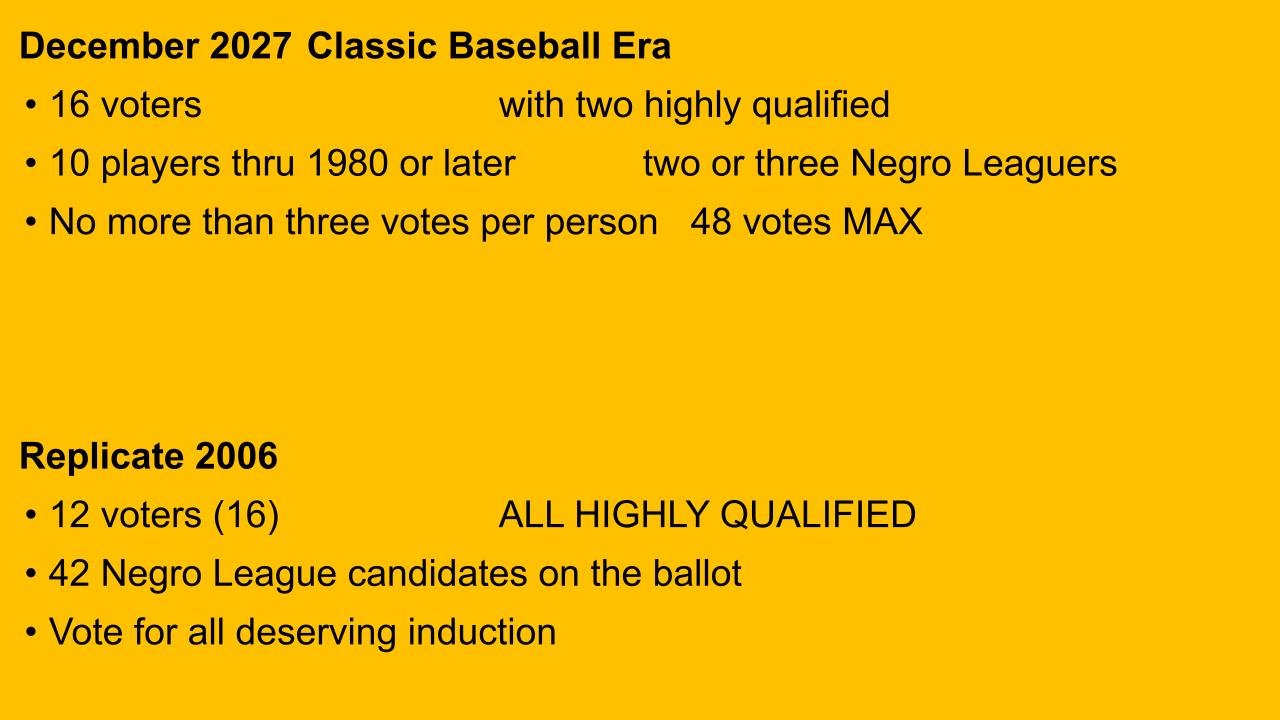
The 42 for '21 poll has now received input from 89 Negro League experts – writers, researchers, fans, artists, collectors – thus our results become more meaningful with each added vote. A total of 154 players, managers, executives, and even a couple of umpires have been considered. The top ten vote getters – all of whom falling two standard deviations beyond the mean of this poll – are shown in the PowerPoint slides.
In addition, to the top ten it is useful to see the top two at each position:
Executive Gus Greenlee C.I. Taylor
Pioneer John Donaldson Fleet Walker
Manager Vic Harris Candy Jim Taylor
RHP Dick Redding Chet Brewer
LHP George Stovey Nip Winters
Catcher Quincey Trouppe Ted Radcliffe
1st base Bill Pettus Edgar Wesley
2nd base Newt Allen George Scales
3rd base John Beckwith Oliver Marcel
Shortstop Dick Lundy Grant Johnson
Left Field Fats Jenkins Chino Smith
Centerfield Spottswood Poles Alejandro Oms
Rightfield Rap Dixon Wild Bill Wright
The above are all in order of position with the exception of Chino Smith who was the 5th ranked outfielder and with the next left fielder not appearing until just outside the top 50 it was appropriate to keep Smith on this list.

OUR MISSION
Justice for Negro Leaguers
There are several ways of looking at how equitably the Negro Leagues & Black Baseball are represented in Cooperstown. One way is to compare the percentage of Negro Leagues & Black Baseball players in the Hall of Fame who debuted in the Segregated Era to the percentage of African American or Latino players in the Hall of Fame who debuted in the Integrated Era.
Currently, only 17 percent of players in the Hall from the Segregated Era come from the Negro Leagues & Black Baseball, while 44 percent of players from the Integrated Era are African American or Latino. That is a huge disparity and shows how much more attention needs to be paid to players from the Negro Leagues & Black Baseball.
Following the lead of the Josh Gibson Foundation's campaign to have the BBWAA’s Most Valuable Player Awards named after the immortal Josh Gibson, we hope to bring much needed attention to these distinguished but overlooked Negro Leagues & Black Baseball players, managers, umpires, executives, and pioneers.

The Holy Trinity of the Negro Leagues: Satchel Paige, Josh Gibson, and Buck Leonard—the first three Negro Leaguers elected to the Hall of Fame. Vintage image one of a series in 1970s marketing campaign for Seagram’s 7 Whiskey.
—Courtesy James A. Riley and BlackBaseball.com